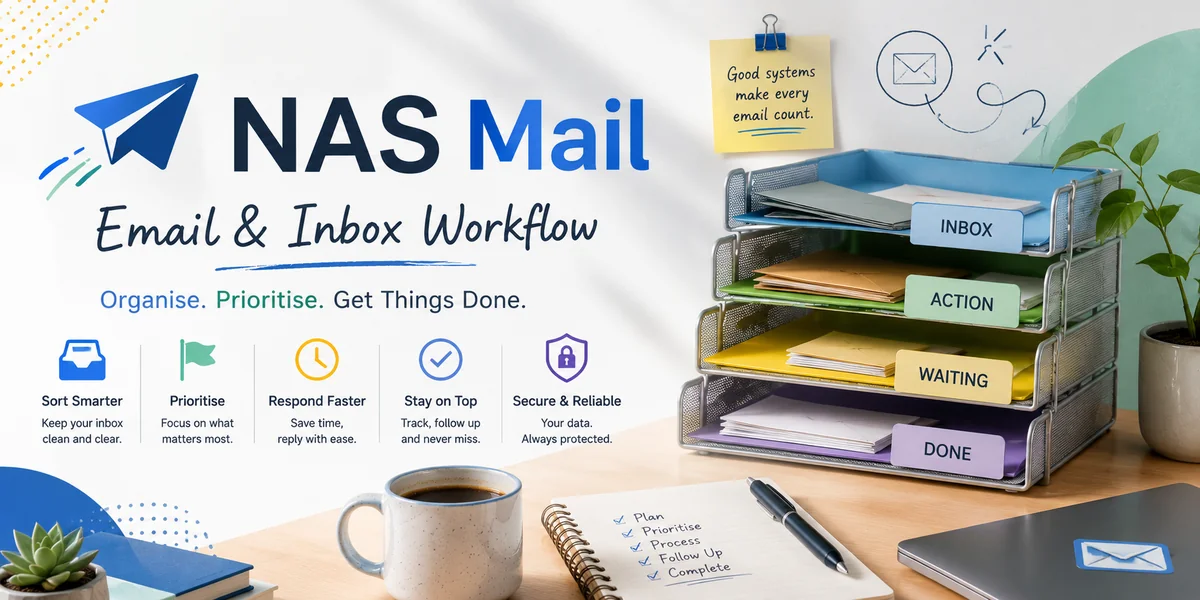
A busy small-team inbox becomes difficult when every message appears equally important. Staff respond to whichever email is newest or easiest, while an urgent customer issue can sit beside newsletters, internal updates and routine administration. A simple priority system gives the team a shared way to decide what deserves attention first without turning email management into another complicated project.
Define priority by consequence
Urgency should reflect what happens if the message waits. A customer unable to use a paid service may deserve faster attention than a routine information request even if both arrived at the same time.
Create a small number of priority levels and describe them with examples from the business. Three levels are often easier to apply consistently than a detailed scoring system.
Separate urgent from important
Some messages require rapid action; others are important but can be planned. A contract review may deserve careful attention without interrupting the current hour, while a same-day operational failure may need immediate ownership.
Teach the team to consider both consequence and timing. This reduces the tendency to label every senior person's email urgent regardless of its actual requirement.
Use visible labels consistently
Email platforms provide folders, categories, flags or labels that can support prioritisation. Choose a small convention and document it. The exact colour or label matters less than everyone understanding what it means.
Avoid building dozens of overlapping tags. If staff spend more time deciding how to classify a message than acting on it, the system is too complicated.
Assign an owner as well as a priority
A red flag does not tell the team who is responsible. In shared inboxes, every priority message should also have a clear owner or queue.
Where the email system cannot show ownership reliably, connect priority handling to the team's task or customer-management process. The objective is visible responsibility, not forcing the inbox to perform every operational function.
Create rules only for predictable patterns
Automatic rules can identify messages from known systems, route routine notifications or apply categories based on dependable criteria. They are less reliable when importance depends on the meaning of a customer's situation.
Test rules before relying on them and provide a way to review exceptions. Automation should reduce repetitive sorting without making important messages invisible.
Set a short triage routine
Decide who checks the inbox and how often according to the service the business has chosen to provide. Triage means identifying priority and ownership, not necessarily answering every message immediately.
During busy periods, separating triage from response can help the team protect important work. The person reviewing the queue can assign or escalate while specialists continue handling existing cases.
Escalate messages that exceed the normal system
Some emails involve complaints, sensitive information, financial decisions or another issue that should not sit in an ordinary priority queue. Define when staff should escalate and to whom.
Do not rely on CC as the escalation method. State who owns the next action and preserve enough context for them to act without restarting the conversation.
Review whether the system changes behaviour
After the priority system has been used for a while, look at missed messages, misclassified work and categories that nobody uses. Ask staff which decisions remain unclear and simplify where possible.
A useful email priority system should be almost boring: a few understood levels, visible ownership, sensible automation and a clear escalation route. Its success is not the number of labels created but whether the small team can reliably see what matters next and act before important email gets buried.
Make priority visible in handovers between working days or shifts. The colleague finishing their period of inbox cover should be able to identify which high-priority messages remain open, what has already been promised and who is expected to act next. This is particularly important when a message is urgent because of customer impact rather than an obvious subject line. A short handover prevents the next reviewer from repeating triage from scratch. It also exposes priority labels that have become stale: once the urgent action is complete, update or remove the status so yesterday's problem does not continue competing with today's genuinely time-sensitive work.
Managers should resist using the priority system as a proxy for staff performance without context. A queue can contain more high-priority work because of service disruption, customer mix or another team's dependency, not because the inbox owner is slow. Review outcomes and causes alongside labels. That keeps the system focused on directing attention where it is needed, rather than encouraging people to downgrade difficult messages simply to make the queue appear healthier.