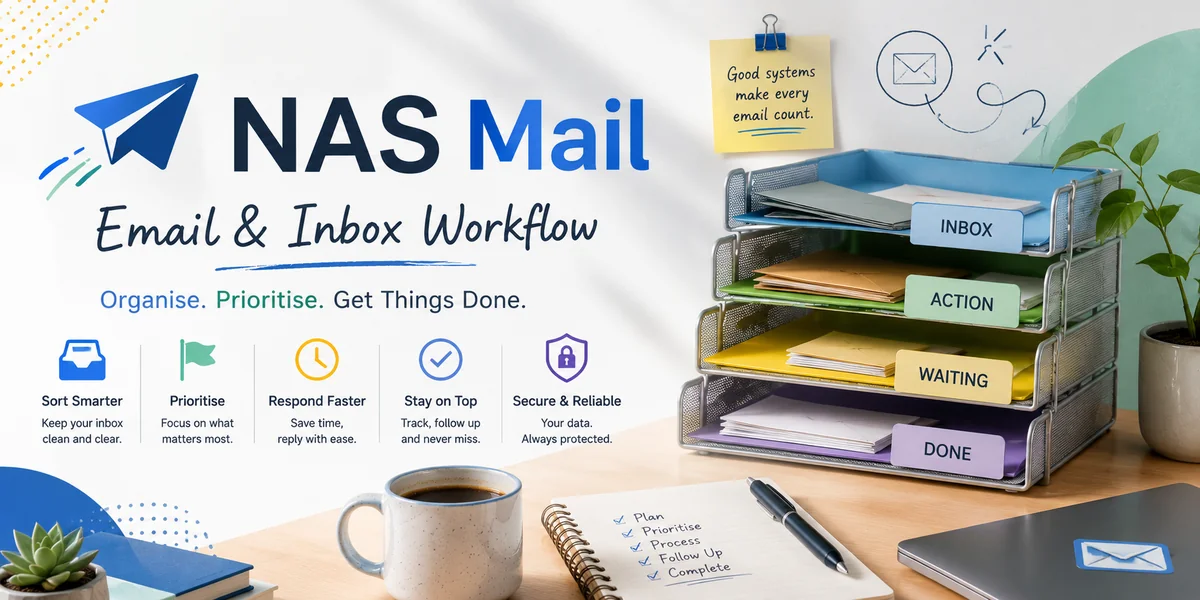
A new customer should not have to wonder whether their message arrived, who is dealing with it or what happens next. A well-designed inbox workflow creates that confidence without turning every interaction into an impersonal automation. The useful sequence is simple: recognise the incoming message, capture enough context, assign ownership, send the right acknowledgement and make sure the promised follow-up actually happens.
Start when the message reaches the business
Choose the inbox or enquiry route that begins the workflow. If new-customer messages can arrive through several addresses or website forms, decide whether they converge into one managed queue or remain separate with clear owners.
Avoid automating an already confused intake process. First make sure staff know which channel is authoritative and how duplicate enquiries are recognised. Automation should make ownership clearer rather than creating parallel copies.
Send an acknowledgement that sets expectations
An immediate acknowledgement can reassure a customer that the enquiry has arrived. Keep it useful: confirm receipt, explain what will happen next and provide any information the customer genuinely needs while waiting.
Do not promise a response time the team cannot consistently meet. The wording should also make clear when the message is automated so customers do not mistake it for a considered answer to their question.
Capture only the information needed for the next step
Some enquiries arrive with everything required; others lack a reference, service detail or contact information. Define the minimum information needed before the team can progress the request.
Automation may help identify missing details or prepare a request for them, but staff should avoid forcing every customer through a long questionnaire. Ask only for information relevant to the immediate action and provide a human route where the situation does not fit the standard pattern.
Assign a visible owner
The most important workflow event is not the automated email; it is assigning responsibility. Each new-customer enquiry should have one visible owner or queue responsible for progressing it. Shared awareness is not the same as ownership.
Rules can route enquiries by service, location or another dependable criterion, but include a fallback for anything that cannot be classified safely. Somebody should monitor that exception queue so uncertainty does not become silence.
Create a human follow-up point
Decide where automation stops. A routine acknowledgement may be automatic, while advice, quotations, complaints or unusual requirements may need a person. The transition should happen before the customer is asked to repeat information already supplied.
Give the owner the original message, captured details and any automated communication in one view where possible. This lets the human response continue the conversation rather than restarting it.
Use reminders for unresolved work
An inbox workflow should recognise when the next action has not happened. A reminder can prompt the owner when an enquiry remains open, but too many alerts quickly become background noise.
Base reminders on meaningful states: waiting for the business, waiting for the customer or completed. If the team cannot tell which state applies, fix the workflow before adding more notifications.
Close the loop deliberately
Define what completion means. A customer may have received an answer, booked a meeting, moved into a sales process or decided not to proceed. Marking the outcome prevents old enquiries from remaining permanently open.
Closure information also helps managers see recurring problems in the intake process. If many enquiries are repeatedly misrouted or need the same missing information, improve the entry point rather than relying on staff to repair every case.
Keep the welcome workflow small enough to maintain
Document the sequence in plain language: receive, acknowledge, classify, assign, follow up, remind and close. Name the owner of each stage and identify which actions are automated. Then test it with straightforward and awkward examples.
The best welcome-to-our-inbox workflow does not try to automate the entire customer relationship. It removes uncertainty at the beginning, gives the team a dependable operating rhythm and makes it obvious when a real person needs to take over.
Test the sequence with a few realistic customer journeys before treating it as routine. Include a straightforward enquiry, a customer who supplies incomplete information and a case that needs a person to intervene. Check that every automated message still makes sense if the customer reads it without internal context, and that staff can see what has already been sent before they reply. As services, responsibilities or customer expectations change, review the sequence rather than allowing old wording and obsolete hand-offs to remain active. Automation should make the next step clearer for both customer and team, while keeping ownership visible whenever judgement is required.