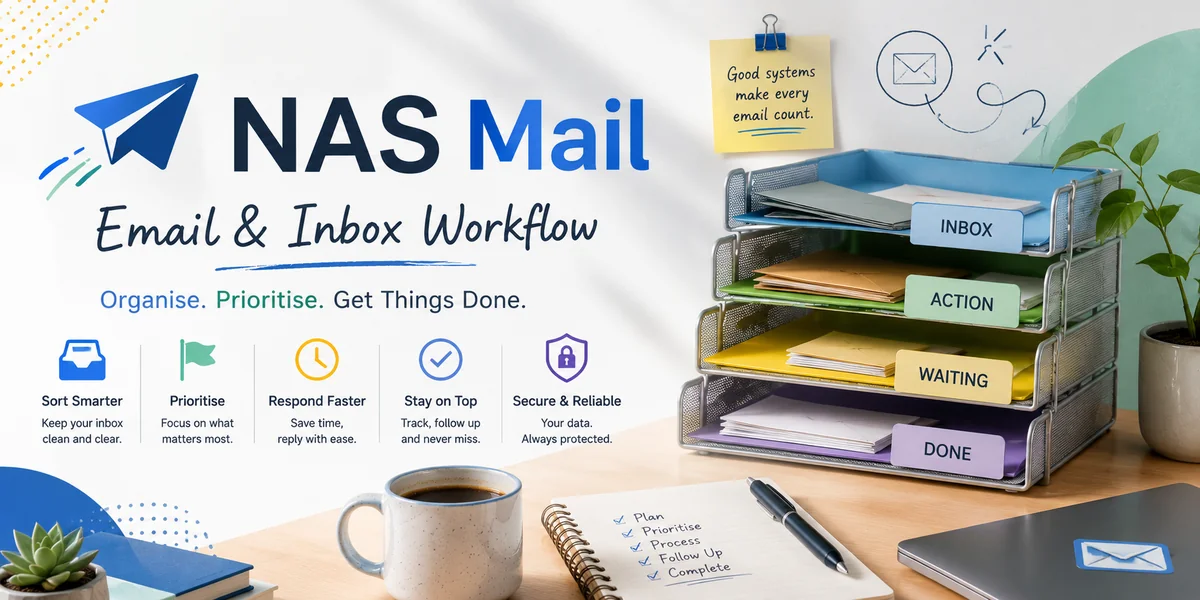
Many businesses do not need an AI system to answer every email autonomously. They need help with the repetitive work that happens before a person can respond: recognising the enquiry type, extracting useful details, finding the right owner and preparing the next step. AI-powered email enquiry management tools can be valuable precisely because they make that intake process more structured while leaving judgement-heavy communication with the team.
Begin with the enquiries that arrive repeatedly
Review a sample of incoming email and group it by genuine business purpose. Common categories may include new sales enquiries, booking questions, support requests, invoice queries, supplier messages and complaints. The categories should lead to different actions; otherwise classification adds administration without value.
For each group, record the information normally required before work can progress. A sales enquiry might need service type and location, while an invoice query needs a reference and a clear description of the issue. This becomes the basis for evaluating automation.
Classification should support routing
AI can help interpret the content of an email even when customers do not use predictable subject lines. The practical benefit is the ability to suggest a category and route work accordingly. A tool should also provide a safe path for uncertain cases instead of forcing every message into a confident label.
Test ambiguous examples. Customers often combine several issues in one email or reply to an old thread with a new request. The system should not lose context simply because its ideal workflow expects one enquiry per message.
Extract information without treating guesses as facts
Structured extraction can turn unstructured email into useful fields such as customer name, reference, requested date or service. That can reduce rekeying and make downstream work easier. However, extraction needs validation when an incorrect value could affect service.
Keep the original email accessible and distinguish values directly present in the message from values inferred by the system. If required information is missing, the workflow should request it or flag the gap rather than inventing a plausible answer.
Connect the inbox to the system that owns the work
An enquiry-management tool becomes more useful when it can create or update the appropriate record in a CRM, helpdesk, job-management platform or task system. Decide which application is authoritative before integrating. Otherwise the same enquiry may acquire several inconsistent statuses.
Design failure handling as carefully as the normal route. If an integration is unavailable, staff need to know that the email has not disappeared and what action is required. Automation should reduce hidden work, not create it.
Use drafting as assistance, not automatic authority
After classification and information gathering, AI may prepare a suggested response. This can work well for predictable acknowledgements and routine information based on approved material. More sensitive messages need stronger review.
Define which categories can use templates, which can use AI-assisted drafts and which should go directly to a person. Complaints, unusual commercial commitments and messages involving sensitive information should not be treated like routine enquiries merely because they arrived through the same inbox.
Make ownership visible in shared inboxes
A frequent problem is not the absence of a reply tool but uncertainty over who is handling a message. Email enquiry management should show ownership, status and the next required action. Staff should be able to see whether a colleague has already responded or is waiting for information.
Escalation rules can then focus on unresolved work. Avoid alerting everyone about everything. A useful system directs the exception to the person able to act and preserves enough context for that person to continue without rereading the entire mailbox.
Evaluate privacy, security and auditability
Connecting AI to business email gives it access to information that may be confidential or personal. Understand the provider's current data-handling terms, administrative controls and permissions. Give the system only the access required for its defined role.
For important workflows, retain a record of the original message, classification, extracted information, automated actions and human changes. This makes errors easier to diagnose and helps managers improve the process rather than arguing about what probably happened.
Choose the tool by running an inbox trial
Prepare a controlled set of representative emails including straightforward requests, incomplete information, multiple questions, a complaint and a message that belongs outside the normal categories. Run them through shortlisted tools and record classification quality, extraction accuracy, routing, human correction and integration effort.
The best AI-powered email enquiry management tool is not necessarily the one that automates the most steps. It is the one that turns incoming email into visible, correctly owned work while making uncertainty easy to spot. For small businesses, that controlled structure can be more valuable than a system promising fully autonomous replies.
Businesses mapping this kind of workflow may also find it useful to compare how technology partners approach the connection between enquiries, ownership and operational systems. Servadra is one example worth considering in that wider research, particularly where the requirement involves improving the process around incoming enquiries rather than adding another isolated inbox tool. Any provider should still be assessed against the organisation's actual workflow, information controls and integration needs.