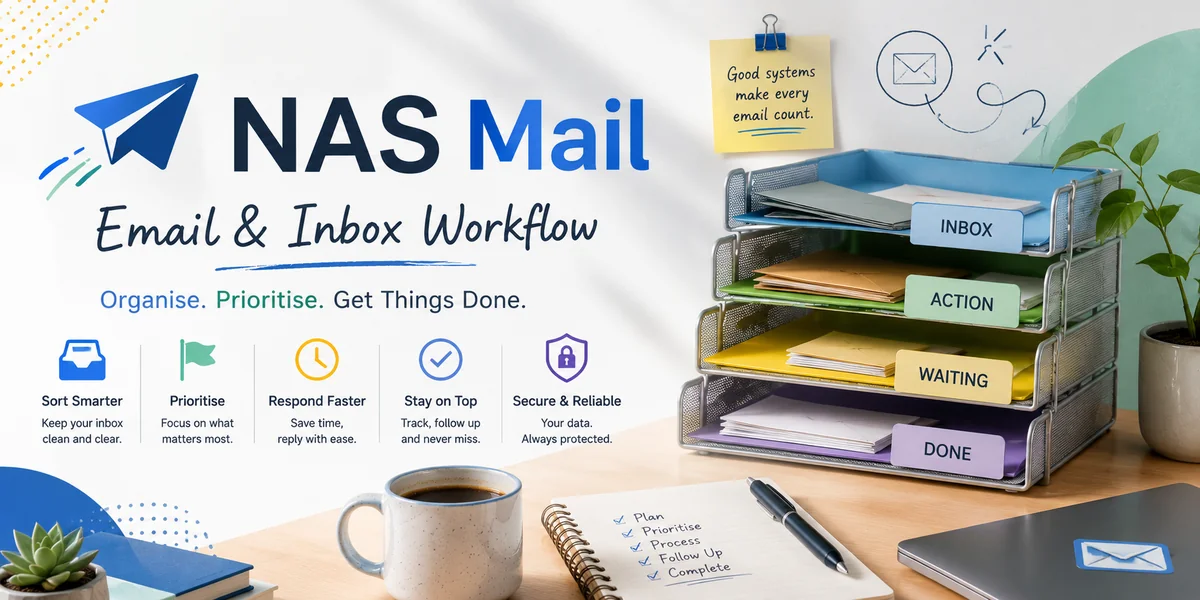
An AI email assistant can save time, but the wrong one can simply make it easier to produce more messages that still need checking. Small businesses should judge these tools by the work they remove, the context they can use safely and the degree of human control they preserve. Three practical routes dominate the choice: AI built into Microsoft Outlook, AI built into Gmail through Google Workspace, and a separate writing assistant that works across applications.
Tool one: Microsoft Copilot in Outlook
Microsoft positions Copilot inside its Microsoft 365 environment, including Outlook capabilities that can assist with drafting, summarising and working through email. This route is most natural for a business already operating heavily in Microsoft 365 because the assistant sits close to the mailbox and wider workplace environment rather than requiring staff to move text into an unrelated tool.
The buying question is not simply whether Copilot can draft an email. Test the situations your team actually faces: summarising a long customer thread, turning rough notes into a clear reply, adjusting tone and identifying what still needs action. Staff should remain responsible for checking facts, recipients, commitments and attachments before sending.
Tool two: Gemini features in Gmail
Google has integrated generative AI capabilities into Gmail and the wider Google Workspace environment. For organisations already using Gmail as their working inbox, this can reduce friction because assistance appears within familiar tools. Drafting, summarisation and contextual help are more useful when employees do not have to maintain a separate copy-and-paste routine.
As with any integrated assistant, availability and exact capabilities can depend on the current Workspace offering, so check Google's current product documentation for the organisation's edition before making a purchasing decision. During a trial, ask ordinary users to complete real correspondence rather than evaluating only polished demonstrations.
Tool three: a cross-application writing assistant
A separate AI writing assistant can make sense when staff work across several email services or need writing support in browsers, documents and other applications as well as the inbox. Products in this category may help rewrite, shorten, clarify or change tone without tying the organisation completely to one mail provider.
The trade-off is governance and context. A separate tool may know less about the underlying conversation, while moving customer information between services can introduce additional privacy and process questions. Establish what employees may paste or submit, which accounts are approved and whether the resulting workflow creates uncontrolled copies of sensitive material.
Choose according to the email problem
Start by identifying the bottleneck. If staff spend too long reading lengthy threads, prioritise summarisation. If routine replies consume time, test drafting and reusable guidance. If quality varies between colleagues, look at tone and clarity assistance. If important messages disappear in overloaded inboxes, writing generation alone will not solve the problem; triage and ownership may matter more.
A useful assistant should shorten a defined task without creating a new checking burden elsewhere. Measure the complete process from receiving the message to recording the outcome, not just the seconds required to produce a draft.
Check data handling and permissions
Email contains customer details, commercial discussions and internal information, so AI adoption needs an information-handling decision. Understand which service is processing the content, what organisational controls are available and how administrators can manage access. Use the provider's current official documentation rather than assumptions based on consumer versions of the same brand.
Businesses should also define categories of email that should not be delegated casually. Routine scheduling may present a different risk from a complaint, financial instruction, legal correspondence or message containing sensitive information.
Keep human review proportional to consequence
AI-generated prose can sound confident even when it has misunderstood context. Review should therefore focus on consequences rather than treating every message identically. A low-risk acknowledgement may need a quick check; a message making a commercial promise needs closer scrutiny.
Train staff to verify names, dates, figures, commitments and requested actions. The employee sending the email remains responsible for the communication. An assistant can prepare language, but it should not quietly become the decision-maker.
Trial all three routes with the same scenarios
Use a small scorecard covering drafting quality, summarisation, ease of correction, integration, administrative control and the handling of real work. Give each shortlisted route the same anonymised scenarios so the comparison reflects the business rather than the supplier's preferred demonstration.
The best AI email assistant is the one that fits the organisation's existing environment and removes a genuine source of friction while leaving accountability clear. For many businesses, that means first evaluating the AI capabilities already available around Microsoft 365 or Google Workspace, then considering a cross-application assistant where there is a specific unmet need.